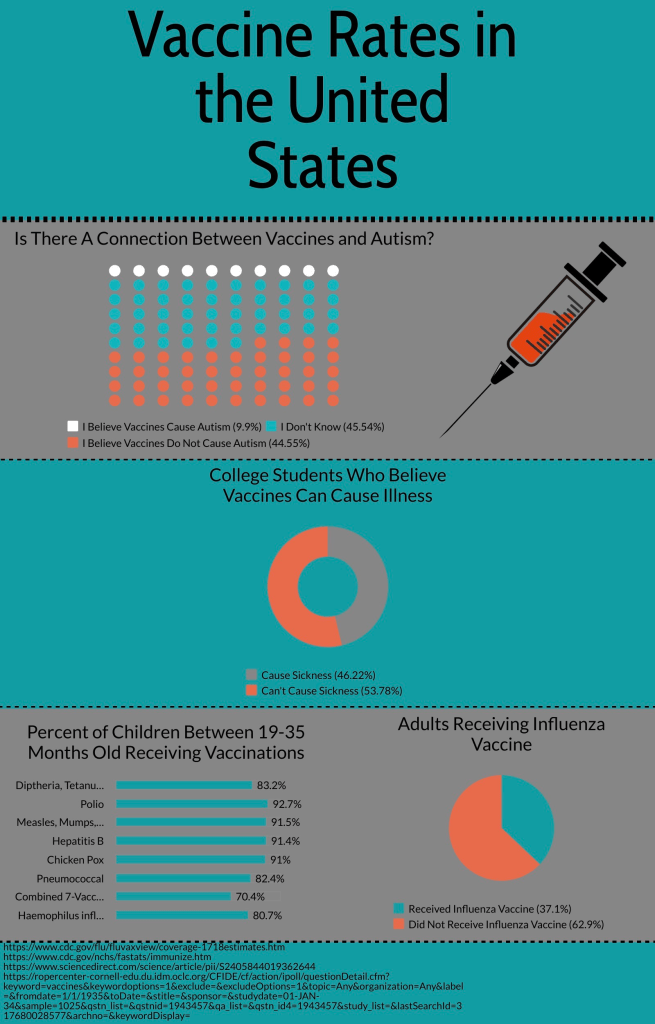
According to the CDC, 37.1% of adults in the United States received their flu vaccine. At the same time, the anti-vaccine movement has spiked significantly in past years, with the belief that vaccines can make one sick or cause autism.
Gallup Organization surveys show that 10% of people in the United States believe that vaccines cause Autism, and 11% believe that vaccines are more dangerous than then the diseases they are designed to prevent.
The majority of people, however, believe that not receiving vaccinations is a dangerous practice, and those who choose to are not often held in the highest of opinions.
“Anyone who doesn’t believe in vaccines is stupid and uninformed,” Paige Stockard, a pre-med student at the University of Denver, stated. “Yes, there is mercury in some vaccines, but nowhere near enough to hurt anyone.”
In colleges specifically, 62% of students received their Influenza vaccine, and 41.6% of college students still believe that the flu vaccine can cause sickness. At the same time, however, 20% of students say that fear of needles stops them from getting a vaccine.
“Everybody should get vaccinated,” Iris Sanders, a biology major at the University of Denver, commented. “My mom is lowkey an anti-vaxxer. She gets mad at me every time I get my flu shot.”
The idea that vaccines can cause the illness it’s trying to prevent is highly argued. However, these vaccines use either parts of a virus, or a weakened or dead version, which is inserted into the body in order to allow a person’s immune system to build response and prevent the host from getting sick in the future.
Many people who are not vaccinated believe that it’s their choice and choosing not to won’t harm anyone. However, when enough people receive a vaccine for a single virus, the virus will likely fizzle away, as there would be no hosts to carry the illness.
Dr. Marcus Deck, a physician in Brunswick, Maine, took the time to explain this idea, which is commonly known as herd immunity.
“My understanding is that it comes from cattle ranching, and if your cattle are spread out in a very large area, it’s impossible to get every single cattle immunization,” Dr. Deck explained. “The concept of herd immunity is that as long as you have about 90-95% of that herd immunized against a particular disease, you might have sporadic cases of that disease, but it’ll never spread. You might have one or two cattle get sick and maybe die, but you won’t have big losses, and the same goes for humans.”
“For many reasons, whether it’s because they have weak immune systems, or they can’t afford it, or they have allergies, not 100% of people need to get immunized,” he continued. “Those individuals are prone to the disease that they’re not immunized against, but, as long as everyone else who can be immunized is, then the chances of them running into somebody who has that disease is incredibly.”
Furthermore, those with immune deficiencies may not be able to receive vaccines in many cases, and people who choose to put off their vaccinations put those people in risk.
“It’s not only a personal choice when somebody chooses not to vaccinate, but they actually potentially affect the health of someone else in a very serious way,” Dr. Deck said. “It’s incredibly selfish and puts the public at risk. It’s like saying ‘I don’t care that we all drive on the right side of the road, I’m going to drive on the left side’. While if not on highways, others may be able to avoid them for a while, eventually they’ll hit another car.”
As of now, 45 states allow religious or personal belief exemptions from vaccinations for attendance in public schools and other public programs. Five states, California, Mississippi, West Virginia, New York, and Maine do not allow either of these, with Maine being the most recent to change their laws.
“In certain scenarios, exemption from vaccinations should be allowed, in certain scenarios, however, they should not,” Skyler Davidson, a University of Denver Political Science major stated. “I think as long as you can continue to maintain herd immunity then yes.”
Measles, which can cause skin rashes, white spots all over the body, fevers, and much more, is one of the more common illnesses brought up when discussing vaccines and whether or not they should be required.
Measles outbreaks have become much more common in the United States in recent years, and in 2019, 1282 cases were confirmed, the highest since 1992. In 2018, the numbers were only at 375.
“About six months ago, for a number of reasons, in the Samoan islands, the measles vaccines rate got, I think, as low as the 20 percentile, there were superstitions, and somehow, a doctor gave a vaccine wrong or something and actually hurt a patient, causing a lot of talk about trusting vaccines,” Dr. Deck explained. “A breakout happened, causing somewhere around 48 kids to die, and you know damn well that all of a sudden everyone wanted to be vaccinated.”
“Viruses can change, so they probably won’t go away,” Sanders stated. “Maybe they’ll be lesser, and less dangerous, but they won’t go away. That’s why it’s important for people to continue to get their vaccines.”
The internet itself has played a large role in the rise of the anti-vaccination movement. For people who use the internet, 80% choose to take medical advice from online. Sixteen percent of those people searched for information on vaccinations, and 70% of them believed what they saw.
Social media sites, like Facebook, which happens to be the second most visited site on the internet, continue to show anti-vaccination ads despite pushback from many users. Furthermore, these ads are paid for by only two groups, “The World Mercury Project”, and “Stop Mandatory Vaccinations”.
At the same time, Facebook has seen a larger number of anti-vaxxers using the platform to promote their beliefs. In February of 2020, “Stop Mandatory Vaccinations” urged a Colorado mother to not medicate her 6-year old child, leading to his death.
“That’s just stupid,” Davidson explained in response to the February 2020 case. “It’s idiotic. To use social media for mass misinformation campaigns should not be done.”
Vaccines themselves are an often questioned topic, but it’s important to look at the facts surrounding the subject and understanding how they work and their significance to many can be lifesaving.
“Because vaccines are so successful in doing their job, it allows people to believe they don’t need it,” Dr. Deck explained. “If it was kind of not so successful, and people were dying from measles outbreaks left and right, then people would definitely want their vaccines. It’s so effective, and therefore people believe it’s not as important.”
 The MFJS Reporter -- Winter 2020 T-R