We have grown so accustomed to a level of convenience in almost every aspect of our lives. The question then becomes is this a sustainable industry? Most convenience comes at a price to a higher carbon footprint and ride sharing apps like Uber and Lift are no different. They are having a serious impact on our planet and its time we take notice.
Uber and Lift have had an impact on pollution throughout cities in the United States. The question is how do Cities combat this issue? The convenience of ride sharing apps coupled with low price has put taxis and public transit in a state of despair.
Now, at first glance many people think that this would be helpful to not having as many cars on the road and maybe even possibly reduce CO2 in the air. A new study by California Air Resources Board proved this to be a fallacy. In the study they were able to pinpoint some of the exact issues with the apps.
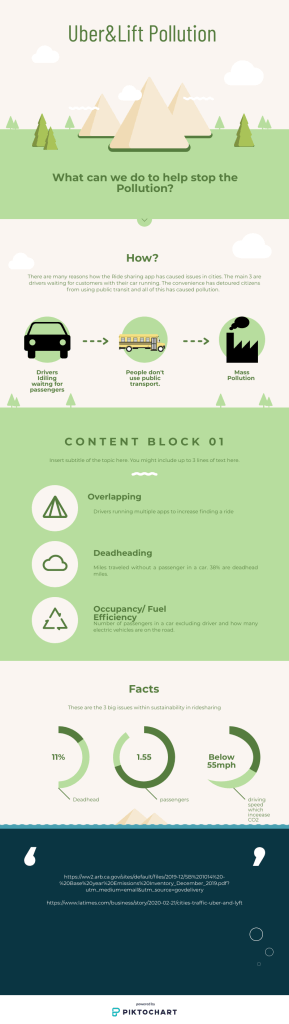
Overlapping trips is common-place while ordering a ride. This happens when riders are multi-apping for a better chance of finding a ride. The study finds that 11 percent of all miles travelled are actually overlapped between two companies.
In an interview with Tyler Jordan a 22-year-old Denver Uber driver reiterated this as definitely something he struggles with when finding drivers. “oh man! It drives me absolutely nuts. This overlapping also happens more often over the weekends when people have had one too many drinks and don’t have any patience.”
Occupancy refers to the number of people in the vehicle. The average is about 1.55. This number suggests that people are not using the pool option and prefer to order their own car entirely.
Another factor is speed limit. Often Ubers are being called from metropolitan areas in cities with stop ad go traffic. Under 55 mph has been proven to increase emissions of CO2 per mile.
In an article by the Los Angeles time they also site issues with transit agencies fighting an uphill battle. “The effect builds with each passing year.” The researchers found that even significant expansion of transit systems would have to expand services by 25 percent just to keep ridership from falling.”
The main combatant is convenience. We as a nation have become so accustomed to having anything and everything managed through our smartphone. We don’t truly think of the impact that ordering a car or laundry detergent from amazon has. It feels like magic that it arrives within 24 hours at our doorstep. The magic is at a price and that price is pollution. People and technology will continue to be a problem as we both fight over quick and less painful ways to navigate through life.
Steve Markle of the EPA had this to say through email.
“We take one step forward and two steps back. Technology is a great thing don’t get me wrong. I think however it is a tough balancing act in regards to ridesharing apps and we haven’t been paying close enough attention.”
Cities need to step in to take charge of Uber and Lift and put greater restrictions on the ridesharing apps. As technology changes we must to be on the lookout for environmental impacts on society.
 The MFJS Reporter -- Winter 2020 T-R