According to the Journal of Broadcasting and Electronic Media, 40% of Generation Z and 38% of Millennials plan to cut the cord on cable subscriptions. In addition, 31% of millenials and Gen Z already have subscriptions to OTT streaming services.
Clearly, the traditional television format is phasing out. As 70 billion dollars are spent on television advertising annually. With the emergence of OTT streaming services, those working in the industry are wondering where all of that money might go.
On a surface level, looking at the steep decline of cable television makes traditional advertising seem like a doomed industry.
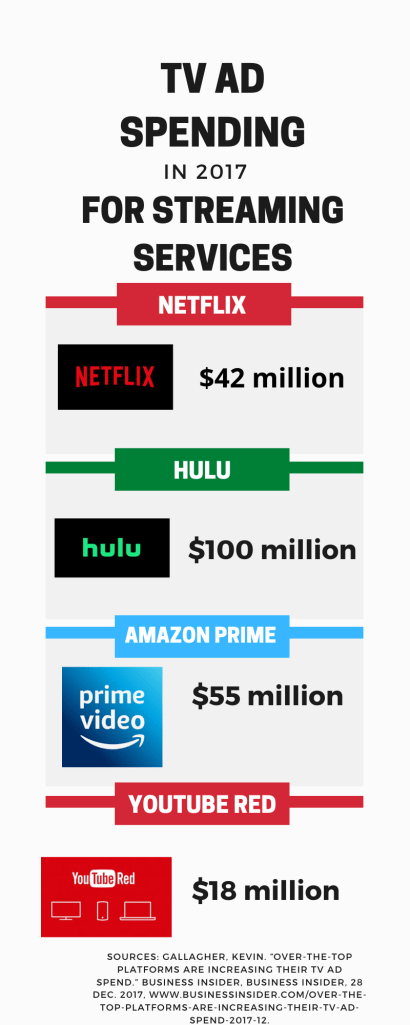
However, media companies are spending astronomical amounts in order to gain licensing and rights to certain movies and television shows, produce original content, and start their streaming platforms. It becomes clear that they’ll need advertisers to offset these costs.
For instance, Netflix has acquired over 12 billion dollars of debt due to their increased production of original content. In addition, Disney anticipates to lose several billion dollars over the next few years due to funding streaming platforms like Hulu, ESPN Plus, and Disney plus.
The Walt Disney company does not expect to turn a profit from any of their streaming endeavors until 2023. However, they have significantly increased their advertising efforts in order to attract more customers as they spent 24.5 billion on running over 2,500 television ads for the platform between September and November of 2019
Fern Martin, a Los Angeles based commercial producer provided some expert insight on these statistics and inquiries about the future of traditional advertising. She has previously collaborated on television ads with Oscar winning directors such as Spike Lee and Grant Heslov.
Martin said, “Traditional advertising is limping along, but, just barely. Coronavirus may be the final blow.” However, she emphasized that new advertising formats are still emerging because of the shift to streaming platforms.
In addition, the budgets Martin has received while working on projects with various ad agencies have definitely decreased. In fact, she says they are now more limited than ever.
Martin said, “Every day we are expected to be more ‘creative’ but the same old systems are running the ad agencies. Clients are now getting very savvy and realizing they don’t really need to go through the ad agency system to make commercials.”
This insight highlights a grim reality for the future of traditional advertisers if they cannot adapt to new formats. However, the streaming platforms actually offer some form of hope for the industry in terms of future work.
Martin said, “The streaming services will always want ads for one thing or another. As you know, none of these services have shown a profit yet.”
In terms of consumer opinion, University of Denver business student Steve Ray said “Generally I dislike advertisements because they can be annoying and they interrupt the content.”
Ray added that he subscribes to multiple TV and movie streaming platforms which amount to about 20 to 30 dollars in monthly fees. He thinks that it is definitely worth it to pay for ad-free content.
Ray said “ I’d rather enjoy the content on it’s own- even with sports content I’d rather just pay for no ads and then see more product placement within the programming.”
However, Ray stated that he has not yet cut the cord on his cable subscription, but only because it is included in his parent’s cable plan which he does not have to pay for.
Ray said, “I have part of my parents cable subscription, so I do get cable. It’s sometimes worth it because there is specific content which is only on cable, however, I think it’s astronomically priced and I wish I could stream all of my content from a consolidated streaming service. If I had to pay for my own cable subscription, I wouldn’t have one but I think it’s safe to say that I’ll be getting rid of it within the next couple years.”
With television advertisements making up nearly 20 minutes per hour of programming, it makes sense that consumers are frustrated.
A study published in The Journal of Marketing Communications showed that although consumers do not have preferences between seeing ads on cable TV or streaming services, advertisements on streaming services are held to higher creative standards by viewers.
This explains why Ray might have preferred integrative advertising formats on streaming platforms such as product placement.
Ray’s responses also aligned with nationwide survey results which show that on average, Americans pay for three subscription services and that 43% of Americans use both cable TV and streaming services to watch their content.
It is clear that viewer expectations have changed in alignment with the shift from traditional television to over-the-top streaming services. In addition, it is important to consider the ways that advertisers have adapted to these changing formats through new forms of brand outreach.
Shoppable ads are a new concept which incorporates a QR code within the advertisement that viewers can scan and then arrive directly to the website or online listing of the product featured.
In addition, product placement is increasingly used as a form of advertising on streaming platforms. In 2018, 91% of Hulu programming included product placement of some kind.
At first glance, it might seem like streaming platforms are causing an end to all traditional advertisements. However, advertisements are still a necessary tool for media companies to turn profits while spending so much on content for streaming platforms.
The future of advertising is unclear, but it depends on those in the industry shifting their content to adapt to new formats and appeal to new markets.
 The MFJS Reporter -- Winter 2020 T-R