University of Denver (DU) students and faculty are all confident in sharing their thoughts about this issue
“I think representation, specifically LGBTQ+ representation in children’s television has improved over the years, but still has a long way to go,” said DU Media and Culture Writing Professor Zoe Tobier. “I think certain television networks are afraid to make quick changes as they know they’ll get backlash. But the backlash is inevitable and shouldn’t stop them from obviously doing the right thing.”
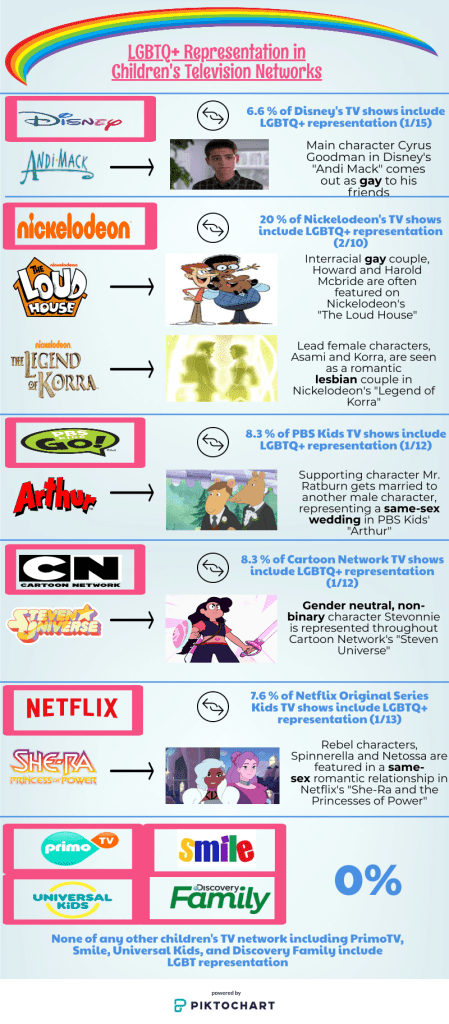
As the representation has increased, the backlash has increased as well. In 2019, PBS show, “Arthur”, released an episode featuring a same sex wedding between supporting character, Mr. Ratburn, and another male individual. Immediately following this, Alabama Public Television (APT) decided to not air the episode in their state.
“If APT had aired the episode, the station would have taken away the choice of parents who felt it was inappropriate for their children,” said APT Director of Programming, Mike Mckenzie.
Backlash also occurred back in 2005, when PBS planned to release an episode from the series “Postcards from Buster”, in which the animated bunny visits children of a lesbian couple. Education Secretary Margaret Spellings stated disapproval of the planned episode, so PBS withdrew plans for airing.
DU student Bergen Sullivan feels very strongly about the backlash that has risen and believes that it is discriminatory.
“I just don’t get the backlash, I mean you see heterosexual couples all the time in kids shows, why can’t we see same sex couples in these same shows?” said Sullivan. “When someone says that sexuality shouldn’t be shown to the youth, that is another way of saying they are in favor of discriminating and want to push the LGBTQ+ community away.”
Another children’s show that has incorporated an LGBTQ+ character is Disney’s “Andi Mack”. In their recent 2019 episode, titled “One and a Minyan”, lead character Cyrus became the first Disney character to ever say the word “gay” when he comes out to his best friend in the show.
Interestingly enough, the six children’s television shows that incorporate LGBTQ+ representation, have all received high success rates. “The Loud House” became the number-one children’s animated series on television within its first month on air. In fact, the show’s highest rated and successful episode with 2.28 million viewers, “Two Boys and a Baby”, was the debut of the show’s Harold and Howard Mcbride, a gay couple.
“I think their [the shows] high success rates are probably because it’s a change in television that no one has really seen before, so people are interested to see how it plays out,” said DU student, Matt Oltman. “I would think people that are against it and people that agree with it are both watching it simply because it’s different and new.”
Other DU Student, Charles Kelly, believes the high success rates of these shows are because of different reasons than pointed out by Oltman.
“I think they receive high success rates because people like to see their traits on television,” said Kelly. “A huge portion of the LGBTQ+ community, including myself, watches these shows often because we can connect to it on a deeper level as it relates to us.”
After the episode of “Andi Mack” where lead character Cyrus comes out as gay, according to Deadline, the show grew by 50% in total viewers (2.1 million vs. 1.4 million). “Steven Universe”, a show that has featured multiple LGBTQ+ characters since its first episode, has one of the most active fandoms (1,873 pages on Fandom), and holds above a 90% audience score on all five seasons, according to Rotten Tomatoes.
As an addition to LGBTQ+ characters in children’s shows, many, including DU student Charlee Manne, believes LGBTQ+ representation includes the addition of dialogue, LGBTQ+ culture, and broken stereotypes.
“LGBTQ+ representation means that dialogue should be represented as well. Kids shows need to stop assuming sexuality amongst characters through their dialogue, and be more inclusive,” said Manne.
In Cartoon Network’s, “Steven Universe”, character “Stevonnie” is shown as a character whose gender and sexuality are never revealed. Throughout the show, Stevonnie is referred using the pronouns: they and them.
“I think it’s great that Steven Universe added that character,” said Manne. “The show’s character and the use of those pronouns helps non-binary people by continuing the effort to normalize people who don’t conform to one specific gender. I think the media plays a big role in how kids think, so this definitely helps.”
A University of Akron School of Family and Consumer Sciences study supports this point by saying television is perhaps the form of media most influential in shaping ideas of appropriate sex roles. They mention that the research on television viewing and the socialization of children indicates television has a great impact on the lives of children, and that children will even imitate and repeat what they see on television.
“People are easily influenced by television and film, especially children,” said Professor Zoe Tobier. “They will exhibit gender biased behaviors and develop gender biased attitudes that they see modeled on television.”
According to the National Center for Biotechnology Information’s research on the “Impact of media use on children and youth”, television shows like “Sesame Street” show how toddlers can learn valuable lessons about racial harmony, cooperation, kindness, simple arithmetic and the alphabet through an educational television format.
“Television is a powerful teacher for sure,” said Oltman. “It is important that valuable lessons are shown on TV, as it really can make a difference. Children’s shows should make sure that with everything they put on TV, it is beneficial for children to hear. To some people, LGBT characters serve a beneficial need, and to some others, serves as the opposite.”
 The MFJS Reporter -- Winter 2020 T-R