As the population continues to grow our water resources remain fairly the same, meaning over consumption of water can lead to drought and deficit.
In the article ‘Water Resources and National Water Needs’ in the CQ Researcher Richard L. Worsnop explains how people often use a large amount of water unintentionally, like in the indirect water resources needed to produce certain foods.
“The average human being is said to drink about four pints of water a day, but he consumes indirectly much more —between 300 and 2,500 gallons,” said Worsnop.
Indirect usage is also prevalent in the amount of water needed to maintain the different man-made landscapes around us. The average American uses about 96 gallons of water a day on various outdoor needs, more than half of that on watering lawns and gardens.
Different universities across the country are trying to cut back on their water usage by implementing low-flow fixtures, improving water conservation education and a variety of other creative solutions. But the concept of indirect water use is also a problem for many colleges with many campuses utilizing large amounts of water on outdoor landscaping.
Michael W. Kerwin, a geography professor at the University of Denver who specializes in climate change, drought and sustainability, explains how the University grows a variety of high-water plants.
“[The university] landscape that was sort of designed around the midwest of the US, bluegrass with the large trees none of them are native to here so these are all urban landscaping,” said Kerwin.
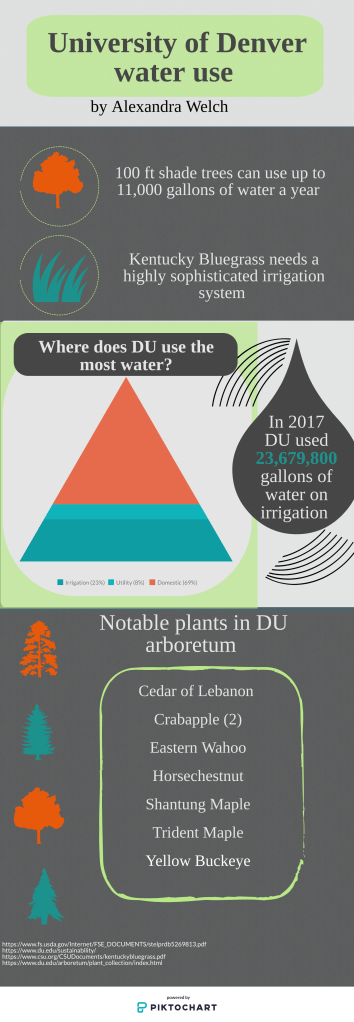
At the University of Denver (DU), 23% of water use is spent on irrigation. In 2017 this amounted to the University using 23,679,800 gallons of water for irrigation.
The DU campus houses the Chester M Alter Arboretum which included about 2,100 tress and several thousand woody plants. Almost all of these plants are not native meaning they need extra water and special care to maintain.
In the University of Colorado’s (CU) 2006 Blueprint for a green campus the water plan explains how the semi-arid climate of the region, which DU also resides in, requires non-native plants to need an excess of water.
“The native plants of this area are accustomed to these water levels while exotic turfs and plants require much more water to survive,” said the CU Environmental Center.
According to the USDA a single 100-foot tree needs about 11,000 gallons of water in a single growing season.With Denver getting an average of 17 inches per year the university must spend a large amount of money on irrigation.
While it may seem that maintaining this elaborate landscaping may financially hurt DU, in reality the University is actually profiting of these idealistic non-native plants.
Around 62% of prospective students claim that the appearance of a campus was the most influential factor when deciding which college they want to attend. Kerwin explains how the appearance of a campus can attribute to the students choice to attend the university.
“There’s a calculus for them if people feel like ‘wow this is a comfortable place where I can sit under that tree and study with my friends’ that’s important,” said Kerwin.
Many college campus are not self-sufficient, meaning the landscaping on the campus could not survive without intensive irrigation. In the peer reviewed article ‘Reveling Campus Nature’ Jeremy L. Bruce explains how this modernized landscaping has severely damaged the native environment.
“On many campuses, natural systems have become so disrupted or altered that they no longer continue to function…all of these modernizing “improvements” have removed the power of natural campus landscape systems to function in a beneficial way,” wrote Bruce in his article.
Bruce explains how colleges have disrupted natural drainage patterns with pipes for irrigation and water supply. Also colleges have removed productive soils that can harbor native plants and replaced it with a variety of different landscaping.
Without the use of irrigation and intensive landscaping DU would essentially be a grassland with little to no trees or lush grass. The question is: Would DU students have been as interested in the university if it had native plants that have adapted to the semi-arid climate.
Meghan Munson, a sophomore student at the University of Denver, does not think she would have chosen this school if the landscape had been drastically different.
“The aesthetic of campus were definitely one of the deciding factors for me, when I toured I remember I sat in the grass and I ate a cheese board snack box from Beans and it just felt beautiful, and the sun was out and it just kind of felt like home,” said Munson.
While certain specific plants such as the characteristically green blue-grass and tall shade trees create the classic ‘college atmosphere,’ some DU students claim the specific plants do not matter. Alex Koon, a junior at the University of Denver, explains how when touring the University she was just looking for common places to hang out outdoors.
“I think that when I was looking at DU the only part of the actual grass and trees that I thought was attractive was looking at Carnagie green… just having an open space to hang out like I don’t care what the grass looks like or what trees there are,” said Koon.
While DU landscaping is a form of tourism in attracting students, the arboretum also plays a part in the psychological safety of the current students. Having access to outdoor areas with a variety of plants can help improve students mental health.
In the article ‘College Campus Landscapes Within a Learning Ecosystem” authors professor Kathleen G Scholl and professor Gowri Betrabet Gulwadi explain how these natural landscapes built into college campuses can improve students health psychologically.
“When designed intentionally, interaction with nature on college campuses can generate perceived and actual benefits in terms of physical and psychological health and well-being, including improved cognitive functioning and learning,” said Scholl and Gulwadi in their peer-reviewed journal.
In addition to the native grassland environment being bad for marketing the campus to prospective students, this landscape might have harmful effects on students mental health.
On DU’s website dedicated to the arboretum DU highlights a variety of different reasons they covered this once deserted prairie landscape into a lush environment.
“The arboretum aims to delight and instruct. It also aims to establish a regional identity for the campus based on collections of trees, shrubs and woody ground covers that enhance the University’s aesthetic, educational and scientific goals,” said DU on their website.
 The MFJS Reporter -- Winter 2020 T-R