For years, there was a significant lack of awareness surrounding the problem of female representation breakthrough in film production. It’s only been during this past decade that a conversation surrounding the issue, both behind the scenes and on screen have been gaining a stronghold among media and society.
The medium of film first came about in the mid 1890s, and oddly enough, the industry was first dominated by women. Once, however, the industry proved to be profitable in the mid 1930s, the men moved in and seemingly did not let go. The men prevailed “above the line” whereas many women were thrown below or thrown away.
This male domination of the American film industry is an incredibly significant topic both within the industry and among scholars who analyze the business. Several interviews with experts and prospective students illustrate such.
“The term above the line refers to professions within the industry of the highest caliber. These guys influence the creative process, director and voice of a film. These people are directors, executive producers, producers, writers, editors, lead actors and cinematographers,” says Jazmyn Tanski, current Directors Assistant for Jaume Collet-Serra in Los Angeles, California.
Such positions, however, positions are overwhelming dominated by a male demographic in Hollywood. More often than not, women find themselves in stereotypically feminine roles, such as Hair and Makeup or Costume Design.
“There is a stigma claiming that women are simply not interested in fulfilling the role of ‘insert top behind the scenes position’ in mainstream filmmaking,” says Lauren DeCarvalho, a film and media professor with expertise in gender and women’s studies at the University of Denver. “Anyone can reasonably assume, though, that’s incredibly inaccurate.”
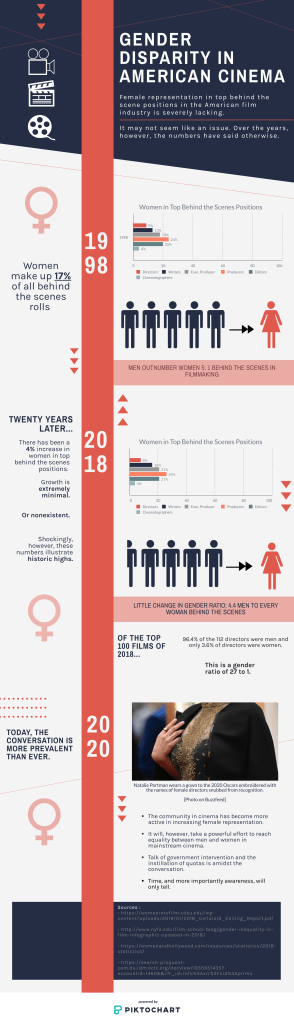
Of the top 250 grossing films in 2019, women made up just 13% of all directors. They appeared most often as producers (27%), editors (23%), executive producers (21%). Women that year also composed just 19% of writers and only 9% of all cinematographers.
These numbers illustrate that little to no growth has actually taken place in terms of reaching equality. Shockingly, however, this 2019 report from Dr. Martha M. Lauzen showcases historic highs in women’s employment in the top 250 domestic films.
Currently, women only make up 21% of all top behind the scenes rolls. In 1997, women made up 17% of such positions, meaning over the past 21 years, women have only made a 4% increase in this specific category.
“Hollywood has a habit of making progress, then falling backwards, especially during the awards season for mainstream cinema. These little increments, however, realistically don’t get us very far,” said DeCarvalho.
Just because women are currently in Hollywood, doesn’t necessarily mean equality has been achieved. A quick look at the numbers is very illustrative of such a notion. Men clearly and overwhelmingly dominate the industry, often to an extreme many people don’t even realize.
“Its definitely disheartening at times,” said Lija Miller, a film and production student at the University of Denver. “As someone looking to enter the business, you see these patterns and immediately assume you’ll fall victim to something you don’t even have much control over,”
But what are the explanations for such underrepresentation, even to this day? And why has little to nothing seemingly changed?
Studies have looked at this question.
For example, a peer-reviewed article in the Journal of Communication Inquiry, published back in 1999, examined a variety of different answers. All of which, however, led the institution in a pursuit for other explanations.
The study ultimately found there is no correlation between the gender of movie audiences and the presence of women behind the screen. There was also no evidence supporting the researched notion that films made by women simply don’t as well as men rather they do just as well, if not even better.
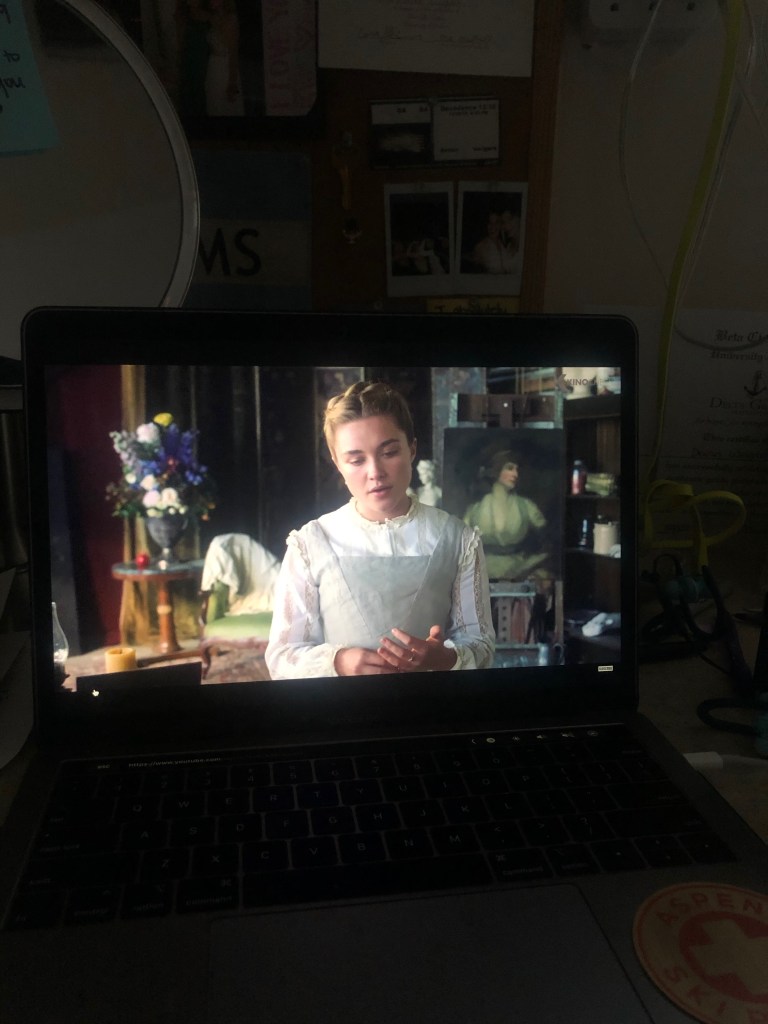
“Little Women is an outstanding historical drama directed by Greta Gerwig. The Oscars snubbed her big time, and since its release in December, the film has grossed over $200 million,” said Claire Arditie, a media student at the University of Colorado, Boulder.
Another explanation this study pondered was the possibility that women are just not interested in working in the film industry and that is reflected in low enrollment figures in the top US film schools. A survey this study conducted, however, found that female enrollment in such schools, like New York University and the University of Southern California, is quite equal to that of men.
The problem is ultimately said to stem from the power dynamics of Hollywood, according to the University Wire, a peer reviewed journal published in 2015. Many however, don’t often see the dynamics and circumstaces as skewed.
“There is a big lack of awareness that there is even a problem when it comes to the limited spots for women in film production. For, why fix what doesn’t appear to be broken?” said DeCarvalho.
Hollywood rides on a network that is historically all male and all white. That power structure has been present for decades, and because of it, the stories written, and the choices made at that top tier reflect the personal interest of those individuals.
This group of people also controls all the financing and all the money. This “Old Boys Network” thus has power over who’s being hired and who’s controlling the process.
“There is not much of an excuse except the fact that blatant discrimination is present. Powerful, wealthy, white men have control over the business, and they don’t plan on letting anyone take it from them,” said Natalie Schafer, a sophomore at the University of Denver.
But how can such change be implemented? Many think it will come down to be a matter of whether or not people are willing and prepared to see shifts in the dynamics of such power.
As acclaimed scholar Dr. Martha Lauzen states in Celluloid Ceiling, “They’ll say, ‘Well, filmmaking is a business, and we try to avoid risk.’ And because there are fewer women out there, they’re perceived as being more of a risk. But the fact is, Hollywood makes risky decisions every day.”
There is undeniably an issue with comfort level and women in places of power in Hollywood. Studios are notorious for not being particularly comfortable with having women at the helm of a production.
“When women do get in there, our stories are able to be heard, and heard in the truest ways. One cannot assume that a man knows entirely what women go through; it needs to be reflected on-screen properly. And do to so, the balance of power needs to be equalized and women need to be behind the camera more,” said Arditie.
 The MFJS Reporter -- Winter 2020 T-R