“It’s really stressing me out, to be honest,” said Sam Urban, a second-year engineering student here at DU.
Jon Ha, a second-year film student at the University of Colorado-Boulder, had a similar viewpoint on the current environmental situation. “As time goes on, I feel more and more pessimistic about the state of the planet and our ability to protect it.”
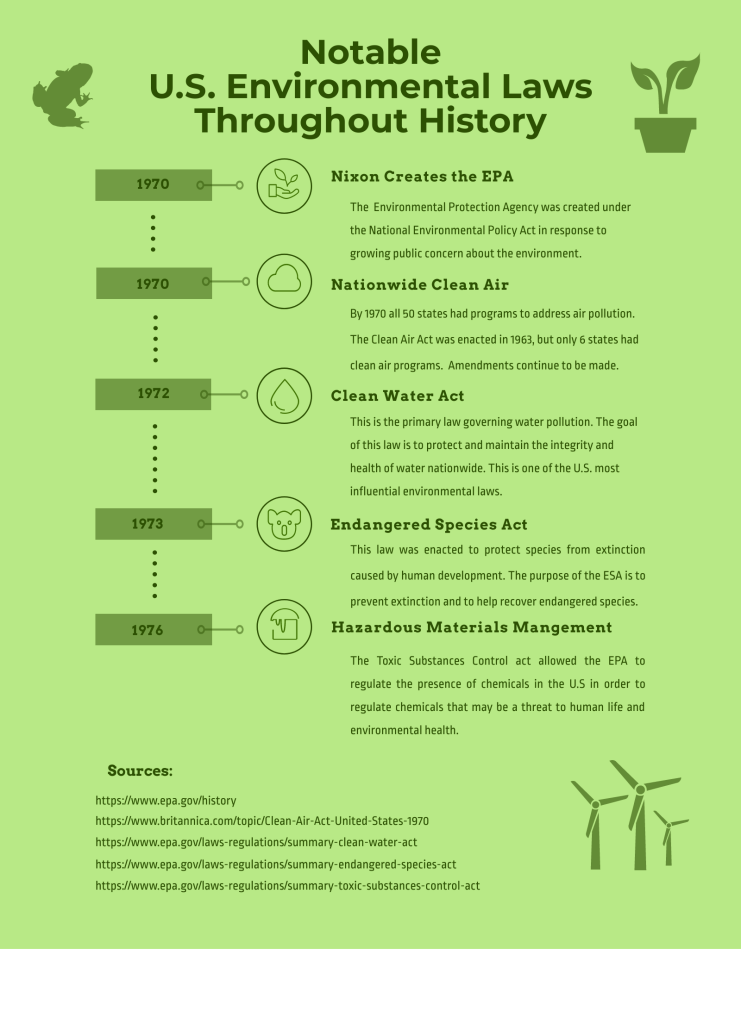
The creation of the EPA in 1970 by President Richard Nixon was one of the first major moves the federal government did to address growing concerns about the environment. 50 years later and our government is still working to manage environmental concerns as they emerge and grow.
The Clean Air Act of 1970 and the Clean Water Act of 1972 were put in place to manage various sources of pollution to our air and water. These legislations worked by putting limits on pollution and punishing those who exceed these limits.
Today, we have a cap-and-trade system to address pollution concerns. Major sources of pollution, like manufacturing, are given allowances to pollute a certain amount and companies are allowed to buy and sell these allowances.
“Big corporations really need to reconsider how they handle environmental issues because they have such a large impact,” said Urban.
A research article from the University of León highlights the importance that corporate responsibility plays in the lives of everyday people. According to this article, the negative effects that large pollution contributors have on the environment has lead to a decrease in overall quality of life because of health issues caused by air and water pollution. The article underlines a “social responsibility” to reduce its environmental impact.
Most of the environmentally related measures that have been made by the government are in relation to regulating practices, as seen in the clean air act. This means it is up to us, the people, to create a more sustainable future if that is what needs to happen.
Today, we arguably have one of the most environmentally hostile presidents ever. Donald Trump infamously pulled out of the Paris Agreement in 2017, an action that meant global climate diplomats would have to carry on without the support of one of the world’s largest economies.
“I’m pretty upset about his views on climate change and overall I disagree with republican plans for the environment,” said Ha.
A 2015 poll shows public opinions of how the government is addressing environmental concerns. At the time, 59% said the government is doing a good job of protecting the environment and 38% said the government was doing a bad job. However, it is important to note that this poll took place before President Trump took office and public opinions may have shifted since then.
In addition to this, we have been facing an increasing partisan gridlock in our federal government especially when it comes to environmental issues. An article from a Yale environmental law professor says that we need to move beyond current methods of regulation to hopefully get past partisan conflicts. Basically, old methods of addressing environmental issues are not suited to the modern-day issues we are facing.
When looking at environmental issues it is important to examine the issue on many levels. While looking at sustainability on a national and global level, we must also look at sustainability practices on a smaller scale as well. For example, we can look at the measures that DU has taken to address some of these environmental concerns.
“I honestly think DU is doing a great job in sustainability,” said Liu, “but of course more can be done.”
Several different organizations and groups on campus, namely the center for sustainability and the sustainability council, have come together to create a plan for how the university will become more sustainable in the future. DU Impact 2025 is part of this plan.
Dr. Rebecca Powell, a geography professor, has been working with the sustainability council and other groups on campus for more than a decade on efforts to make the university more environmentally friendly.
“I’m sort of an organizer-coordinator-cheerleader right now,” Powell said jokingly as a description for her role in these efforts.
Although there are many projects being worked on right now by sustainability groups on campus, one of the most recent ones is the installation of solar panels on many buildings across campus.
It is projected that 7% of campus electricity will come from these solar panels when the project is complete. “It doesn’t sound like a lot, but it’s a big deal,” said Powell in reference to the project.
Projects like these are definitely a big deal on campus. According to the Center for Sustainability website, 7,000,000 kWh, and $675,000 has been saved annually as a result of measures made to reduce energy consumption on campus.
“Living in the dorms, I’m definitely conscious of energy consumption, said Juanlin Liu, a second-year student here at DU, “housing tries to make everyone aware of how they can do their part by being mindful of [energy consumption].”
However, there are challenges that have come along with trying to develop a more sustainable university.
“Right now our barriers are in terms of how to identify where interests between the different units [of the university] align and how we can maximize that alignment so that we increase impact with minimal cost. Part of the problem is the complexity of it all,” said Powell.
This is an issue that is prevalent in sustainability developments at any level. For example, many measures get stuck in congress for similar conflicts between competing interests. “In a lot of ways, it’s a microcosm of what global sustainability looks like too,” said Powell when comparing DU’s barriers to that of the national government.
Because of these roadblocks, the transition to becoming more sustainable takes a lot of time and resources. Powell compared institutions like universities to cruise ships in that they’re both very large and move quite slowly.
Despite whatever issues may come along with creating a more sustainable future here at DU, Powell notes the important role that students play in the whole process.
“Pay attention and demand that others pay attention as well. Talk about these issues, think about these issues. Students should understand the power they have. Sustainability on campus exists because of students.”
 The MFJS Reporter -- Winter 2020 T-R