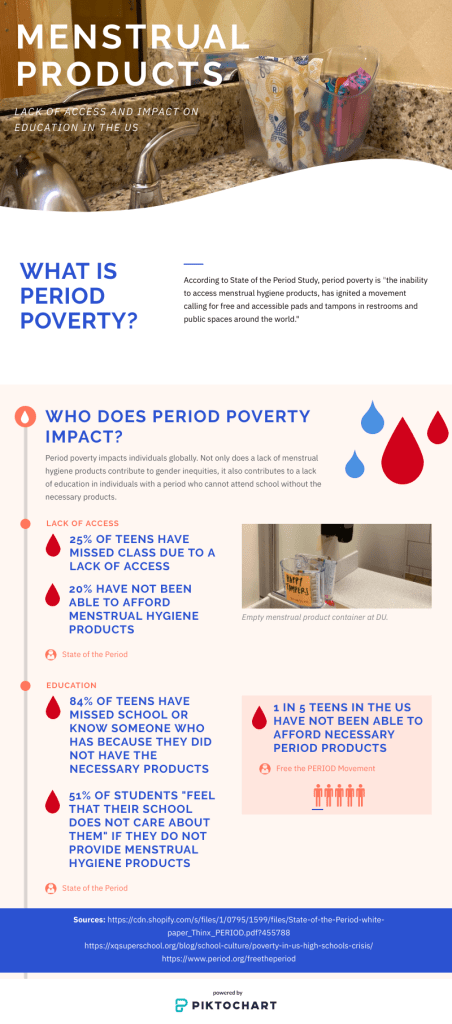
According to the study, State of the Period, “25% of teens have missed class because of lack of access to period products, 20% of teens have struggled to afford period products or were not able to purchase them at all, and 84% of teens have either missed class time or know someone who has missed class time because they did not have access to period products.”
Condoms are not taxed as a luxury and are given for free in many schools across the US. This has proven to be incredibly important in the prevention of STI’s among youth. This stride encourages health awareness in students across America, schools must also support feminine health and dignity through menstrual hygiene accessibility.
The Intersectional Feminists Club at Arvada West High recognized this disparity. This club, according to Arvada West High’s website, “works to achieve gender equality within the school and the larger community.”
The club knows feminine hygiene products to be a right, not a luxury. And wanted to work to ensure students have access to these necessities at school.
Maia Weslar, one of the leaders of the club, explained that, “Our club believes that every menstruator globally should have access to free period products regardless of socioeconomic status. That is arguably the most important reason as to why we started this project.”
The Intersectional Feminists Club reached out to CO State Representative Brianna Titone in Summer of 2019. This team worked to draft a bill, HB20-1131, “Menstrual Hygiene Products in Schools Program.”
According to the Colorado General Assembly website, “The bill creates in the department of public health and environment (department) the menstrual hygiene products accessibility grant program (grant program) to provide awards to public schools or school districts in order to provide menstrual hygiene products at no expense to students.”
Representative Titone spoke at a Legislative Advocacy Workshop in early February, that was organized by IGNITE.
IGNITE is a national, non-partisan organization that works to empower women in political leadership positions. There are chapters in colleges and even high schools across many states in the US. IGNITE is continuing to expand and recently, a chapter at DU was reinstated.
At this event, attendees were taught more about legislative structure and processes, and ultimately learned what average individuals can do to make a difference in terms of government. One instance of tangible change that the Feminist Club aims to achieve is the menstrual product bill that Representative Titone took the time to speak to.
Unfortunately, this process comes with many obstacles, one particularly important aspect being budget.
“We worked hard to bring down the fiscal impact for the bill and when we left the bill waiting to go to Appropriations Committee, we were hopeful that the funding would be approved. That is, until the Coronavirus situation. The response to the virus is having a substantial, hopefully short term, impact on the budget,” said Titone.
Titone is unsure if the bill will be heard in the committee at this time and is working with Arvada’s Feminist Club to “keep the bill alive.”
This global pandemic will, of course, impact the state and progress of HB20-1131. Weslar agrees with Titone and also hopes to reintroduce the bill in future sessions to increase its chances. Regardless of the progress of the bill, Weslar and the Intersectional Feminists Club will continue their work to advocate for menstrual equity.
To further advance the progress made in terms of the bill and towards lessening period poverty, advocates need to focus on education.
Titone said, “it’s more important now to educate people about the need for these products—we need to continue the conversation on the topic so we can pressure the districts to provide the products to all of their students.”
Individuals should also support the organizations that are working to achieve menstrual equity.
“Because our legislative environment is less than thriving right now, we recommend donating money or products to organizations that are working towards menstrual equity. Examples could be Period Kits Denver, Free the Period Colorado, Planned Parenthood CO, and Period INC.,” said Weslar.
 The MFJS Reporter -- Winter 2020 T-R