The idea of being extremely thin, like supermodels, have infiltrated young minds. Unrealistic beauty standards are something that women have been dealing with for years. We can see this through clothing like corsets and large, heavy skirts to achieve a certain silhouette.
According to Kendyl M. Klein’s thesis on this topic, the word “thinspiration” has been tossed around the internet to label the type of body they want. People use this word to describe the ideal body through modes of media like social media, magazines, and television.
You may ask yourself: Why do girls want this body type? Rachel Liberman, Teaching Assistant Professor and current Undergraduate Director in the Department of Media, Film & Journalism Studies at the University of Denver, argues that it’s because of how society has shaped the way we view bodies.
“Social media plus mainstream media plus lived culture, if they’re all working together…the patterns of a certain body type are stronger because you see it in larger culture,” Liberman stated.
Many women now feel pressure from not only their friends online but also the greater public to fill the thin ideal. This causes many psychological issues like eating disorders and restricted eating.
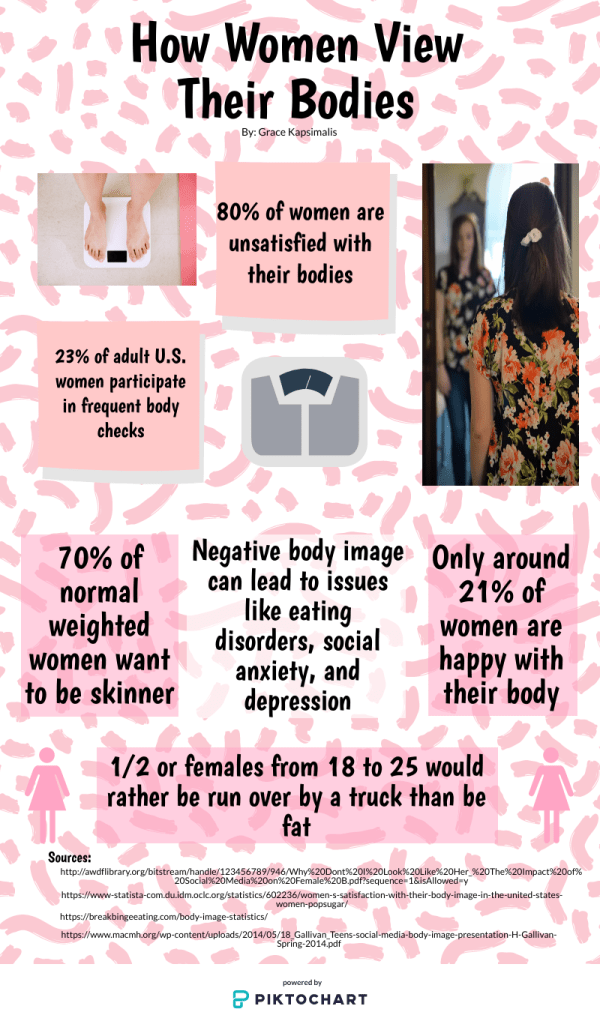
According to Klein, around 20 million women will or have suffered from an eating disorder in their life. The majority of this behavior is seen within the 18 to 25 age range in women. Klein also mentions that over half of women would rather be run over by a truck than be fat.
This is even prevalent, although not to the same degree, on the University of Denver campus. With a demographic that fits into the peak age range for body image issues and the fact that college-aged adults spend so much time online, there is some visibility of the effects on campus.
“For me at least, seeing a lot of different girls on social media just so, so skinny, it’s just everywhere,” Sadie Cotten, a sophomore biology major at the University of Denver discussed.
While trying to fill the ideal they see on the screen, they try to obtain the look through editing their pictures and eating less. Women then look for a way to get physical approval from peers.
Many women seek validation through likes and comments according to a study done by Chelsea P. Butkowski, Travis L. Dixon and Kristopher Weeks. It’s a physical number that tells someone how much they are liked in society. Once one woman sees that it’s working for another, they try to emulate that with whatever means necessary, therefore continuing the cycle.
To add to that, 78% of women use social media and they tend to spend around 153 minutes, which comes to almost three hours daily. By being exposed to these body standards for long periods of time every day, they start to see it as the norm and that they need to fit into that category.
“If you see [the thin ideal] over and over again that begins to have an impact on the way that you then judge the self,” Liberman said.
The thin ideal is a term that some researchers use to describe the way that social media or just media in general shapes how women should look. This ideal tends to look like a woman with narrow hips, long, thin legs, and tends to be tall. The thin ideal tends also tends to show women who are 15% under the average weight for women.
While trying to achieve this unrealistic ideal, women tend to develop eating disorders like anorexia or bulimia. It is estimated that seven million women have an eating disorder and only one in ten seek treatment. Moreover, according to the National Eating Disorders Association, nine out of ten women won’t eat due to unsatisfied body image as a result of media.
This has brought a lot of attention to social media sites like Instagram and Facebook and these users, mainly women, want change. Both sites have started to show differing body types and Instagram has taken initiative and has decided to remove likes from posts.
“I saw this add with a bunch of women above 50 and they’re all different sizes,” Anne-Marie Boardman, a freshman at the University of Denver who is studying communications, stated.
Many groups have taken control of what they want to see and have pushed other bodies on these platforms. The soap brand Dove has started many campaigns, even seen on social media sites, to help further along with the idea that everyone is beautiful.
Although some social media sites are pushing different narratives, not everyone is convinced that it will solve the problem.
“If you take down a certain body types post, that’s fat-shaming or skinny-shaming and that’s not very inclusive. I don’t think they can do much besides promote healthy eating habits and give you encouraging messages,” said Maria Peralta, a sophomore at the University of Denver studying engineering.
There is no way for social media to police everyone’s pictures and say what is right or wrong. Certain pages on these sites are dedicated to healthy lifestyles and some forums give users a place to express themselves and get tips on how to live healthier.
“Online communities foster allegiances and friendship and you feel support,” Liberman stated.
 The MFJS Reporter -- Winter 2020 T-R
great story! I think it’s really interesting and important to read. I also think the infographic is captivating.
LikeLike