Sydney Kenner, a freshman at Boise State, is one of many students experiencing day to day life while dealing with mental health. To Kenner, it is no surprise so many college students seem to be struggling.
“Because college is challenging and everyone is going through huge life transitions it becomes a stressor that can have a toxic effect,” Kenner said.”
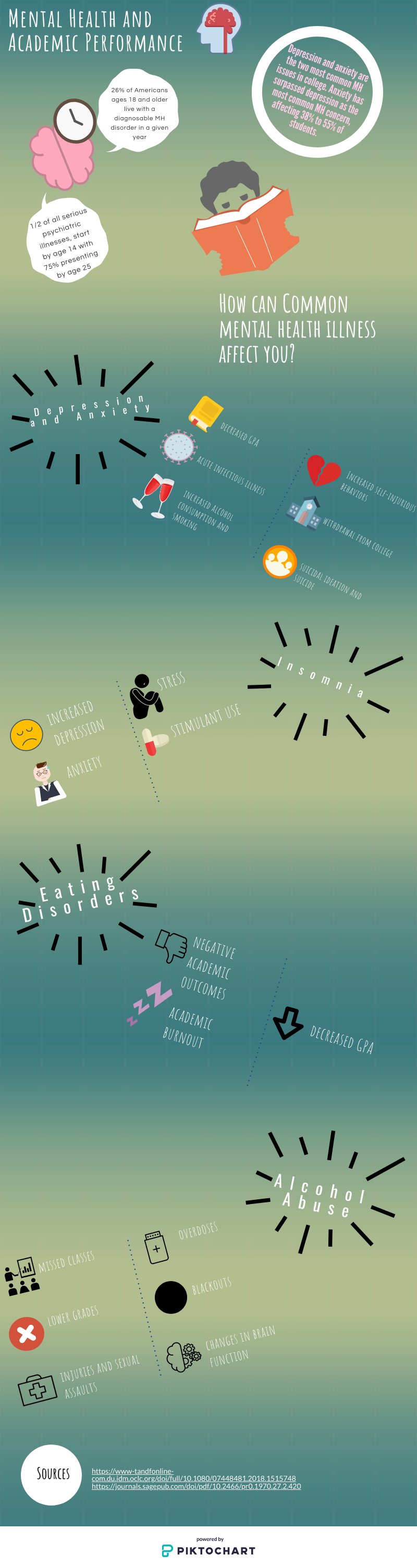
According to the Journal of Affective Disorders, epidemiological studies point to twelve to fifty percent of college students showing signs of one or more mental health disorders. At this point in people’s lives mental disorders are common and can unfortunately lead to long term effects such as lasting emotional and physical health issues and complexities in relationships.
But, along with the commonality of students suffering from mental health issues there is definitive research that demonstrates a direct correlation to academic performance. According to the Journal of Affective Disorders, depression and suicidal thoughts and behaviors are related to a lower grade point average and internalizing and externalizing mental health issues are directly correlated with an average decrease of 0.2 – 0.3 in GPA.
“Finding a balance between my academic intake and taking care of my health is the biggest challenge I face,” Kenner said. “If a student is generally more healthy on the mental health spectrum their grades are more likely to be higher because they are able to absorb more information without having the pressure of dealing with everything on their shoulders.”
While balance can be hard to find addressing mental health issues continues to be important and according to the International Journal of Higher Education, “Understanding stress and mental health issues germane to college students is imperative to their overall well-being and academic success.” Sydney Porter, a freshman attending Austin Community College, tries to keep this in mind.
“For me personally, trying to balance staying at home, losing friends, and trying to find a new place after my whole life in high school has always been a difficulty,” Porter said. “It’s just shocking in the real and raw world where you are suddenly required and expected to be able to function as an adult. I try to not get overwhelmed by whatever mental health issues I may be experiencing in order to be able to function at that level, but it only gets worse if I ignore it for too long.”
Mental health has not always been a priority for anyone, let alone those in the academic sphere. Recognizing it, both as students and teachers, and learning how to address it has been and still is a learning process. According to Barry W. McCarthy, a professor at American University, describes the college experience as, “a series of developmental tasks and crisis periods; these can be intellectual, social, vocational, or personal in nature. [It can include] not only intellectual processes but equally important social, personal, and emotional processes. ”
So, with all of these factors at play mental health is beginning to be acknowledged as a larger influential aspect to a student’s academic performance. Due to this there are steps being taken, such as implementing improved counseling facilities and services, as described by McCarthy. But, despite the attempted advances there are still many areas in academia in which mental health is not being addressed and is now affecting how students perform.
“No, I don’t think there is enough adequate support or accommodations for those suffering from mental illness,” Porter said. “For me, if I am struggling or having a bad day there have been times I just haven’t been able to make school a priority and I have to accept the consequences even if it was the best choice for myself. I think there are some teachers who are completely understanding but others couldn’t care less. The school doesn’t make teachers lookout for mental health issues or accommodate someone suffering from it and I think that needs to change.”
Overall, mental health does present certain obstacles to students that are hard to simply ignore. Whether it be a minor case of anxiety or a severe case of depression students are facing challenges, challenges potentially distracting them from submitting the best quality of work possible.
“If you are having a rough day the last thing you want to do is sit in front of a blank screen and try to prove your skills,” Porter said. “When people have rough days it is harder to get yourself motivated or to pump out good work because it is harder to focus with a dark haze around you splitting your attention. Mental health really does impact everyone’s grades and participation, but in the end I think the most important thing needs to be the student’s well being.”
 The MFJS Reporter -- Winter 2020 T-R