“Rents are too high,” reported Brisson “Housing costs are incredibly high. Much of the public want people experiencing homelessness to fix their own issues – when as a society we have set-up some people to fail.”
“Then there is a pandemic that is killing people. [There are] lots of challenges [facing the homeless],” explained Brisson.
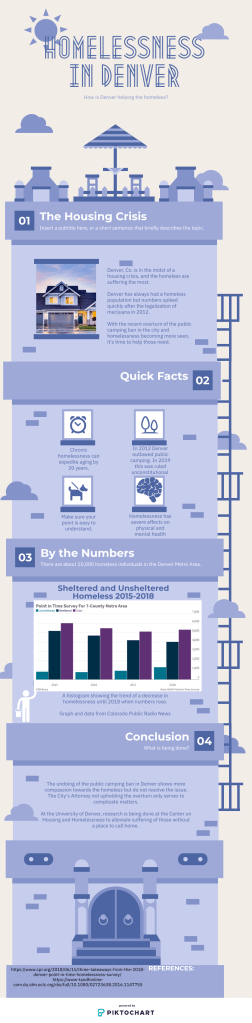
In 2012, Denver passed a city ordinance banning dwelling in public spaces. Dwelling was defined as sleeping, resting, preparing food, eating or storing personal belongings in any publicly or privately owned space. Prior to this point, setting up camp underneath an overpass or alley was allowed, under this law, life had been incredibly disrupted for the homeless.
“There is so much back and forth on the camping ban, it is hard to provide a bried summary on its impact. However, broadly, if you don’t have a home, and you can’t sleep in public, it becomes illegal to live,” stated Brisson.
This January, Denver revoked this law and has once again allowed public camping. In a journal published in 2015 by Sig Langegger, the issues with this ban were brought to light. Denver’s camping ban worked to further criminalize the homeless, Langegger described how “these stigmata also now mark the visibly poor as potential lawbreakers.”
In December 2019, Denver County Judge Johnny Barajas ruled that Denver’s camping ban was unconstitutional, specifically citing Denver’s inadequate shelters as a reason. This has not meant that the homeless are done being victimized by a police force searching for profit. According to the Denverite, the City Attorney’s Office read Judge Barajas’ ruling and decided to resume enforcement of the camping ban.
These changes and flip-flopping have very real consequences for the homeless individuals being severely impacted by these laws.
What seemed like the overturning of a law designed to burden the homeless has not been so successful, so what is being done to help these non-sheltered people? Daniel Brisson, Executive Director of the Center on Housing and Homelessness Research at the University of Denver hopes to make a difference. Brisson’s office leads initiatives focused on researching the causes and effects of homelessness with the goals of alleviating suffering.
Local students from the University of Denver, feel removed from the issue with campus acting as a barrier shielding from privileged eyes from the homeless that struggle finding shelter only a few miles away. Recently students have noticed more homeless individuals around campus particularly around the bus stops on S. University Boulevard. Nick Nielsen, a junior at the University of Denver shared his thoughts.
“It seems as though Colorado has an abnormally large amount of homeless people. Which I would blame on the cost of living in Colorado is just so high,” Nielsen explained
All of the University of Denver students interviewed felt very distanced from the issue of homelessness. Some couldn’t even recall when if at all their last interaction with a homeless individual was.
“The only experience I have interacting with or being around many homeless people would be down at the public library, where I get tutored a lot in math. That’s the only place I feel homeless people can go, in the city at least,” said Nielsen.
Celia Siade-Cox, a junior at the university couldn’t recall interactions with the homeless but was very eager to discuss the camping ban and her beliefs surrounding it.
“I feel like people should be able to, if there’s place, for them to sleep. Like no homeless shelter, then they should be allowed to sleep in public space. Because there is nowhere else for them to go. If their city’s not going to provide somewhere for them to go then they can’t prevent them from sleeping where they need to sleep, ” Siade-Cox explained her stance.
With temperatures rising, the general public may worry less about the homeless as they’re no longer in freezing conditions but they still need shelter. The Colorado government has posted reports detailing the immense health costs of homelessness, stating that “homelessness expedites the aging process, by as much as 20 years.” Conditions typically suffered by the chronically homeless include memory loss, falls, difficulty performing activities of daily living and urinary incontinence.
It is difficult to imagine what life truly is like for a homeless person in Denver for a day, much less a month or even chronically homeless. The experiences these people have are beyond fathomable for some, more should be done to help those in need.
All students interviewed were in favor of overturning the camping ban that was put into place eight years ago.
“I feel like some of the things that the camping ban says as in where [people may dwell] is pretty selective. Like I understand kind of public areas in the city and stuff like that because a lot of people care about that stuff, but under a bridge or something like that, that’s also technically off-limits? I don’t know about that, that’s a little unfair,” said Nielsen.
 The MFJS Reporter -- Winter 2020 T-R