This trend in media distrust and skepticism is a new one. According to NiemanLab, “72 percent of Americans trusted the media in 1976, post-Watergate. By 2016, that was down to 32 percent.”
In 2017, CQ researcher found in a survey “asking about the honesty and ethical standards of 22 professions ranked journalists “low” or “very low.” Only members of Congress and car salespeople scored lower.”
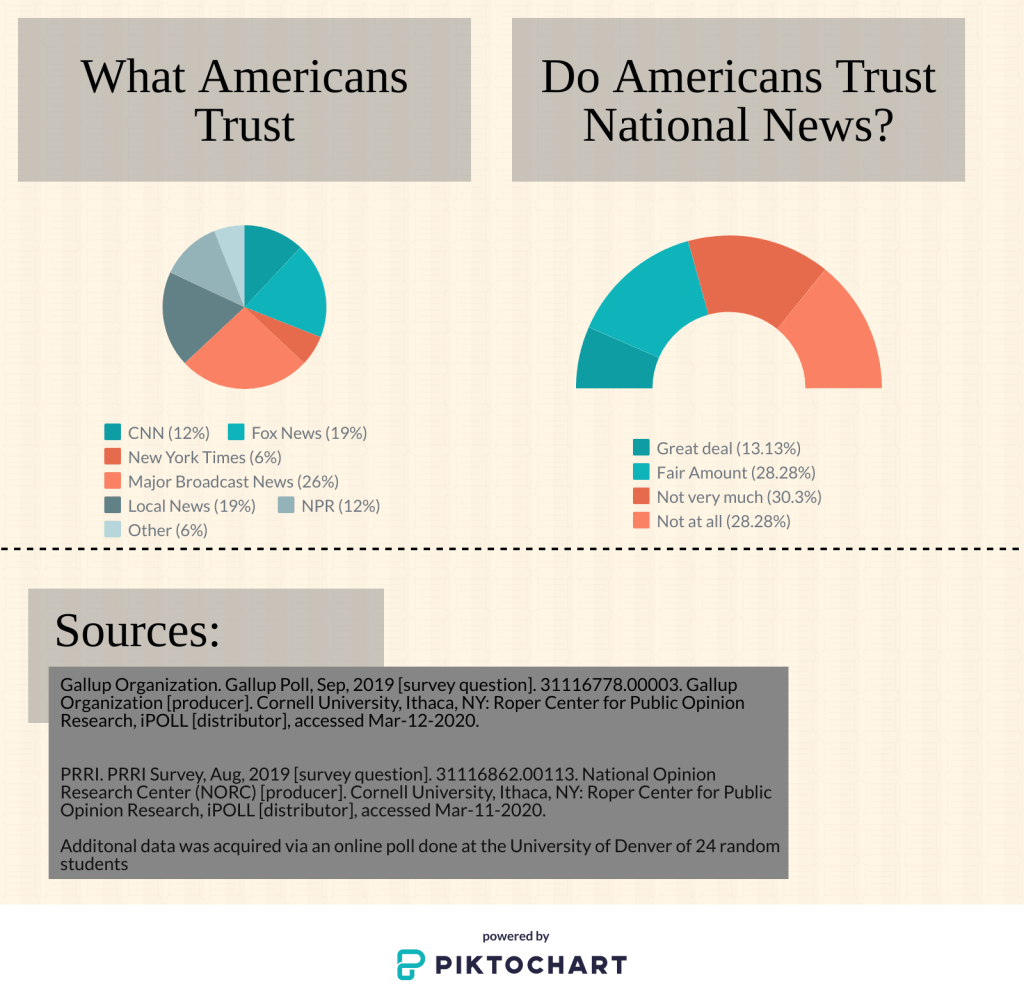
Some college students, on the other hand, have great trust in journalists from national news organizations like The New York Times or The Wall Street Journal. DU 2nd-year student Blaine Tracy said, “I usually get my news from them [The New York Times], I feel they are one of the most objective sources.”
In another survey, CQ discovered that “62 percent of Americans said the media favor one political party over the other, compared with 50 percent in past years.”
Tracy agrees with the national perspective that news organizations have a partisan leaning. Tracy said, “I do, I think everyone is biased, you are just picking which bias you want to learn from.”
The most disturbing result comes from a survey done by Gallup that shows 28 percent of Americans do not trust mass media news at all, with an additional 30 percent who do not trust it very much.
Tracy is split on this issue, “My immediate reaction [when I receive news] is trust but verify, especially if it is something I care about.”
DU journalism professor Dr. Lynn Clark explains that confirmation bias is a huge part of this distrust that students and Americans hold for news organizations.
“The big thing with news and trust is all of us have confirmation bias, which means we have a bias towards confirming what it is we already believe,” said Clark. “So if we think that this thing [coronavirus] right now is being overblown by the media than we are likely to find and read sources that reinforce that viewpoint. And if we think that this is something really serious that we should be following and self-isolating then we will look at news sources that say that.”
So where is this distrust coming from, and what news organizations do students trust in this time of distrust?
Students at DU have mixed opinions on the issue. In a poll of DU students, 37.5% of students said they trusted The New York Times more than any other news organization to present the news fairly and accurately. This opinion by DU students is the most popular with the second most popular being the Associative Press (AP).
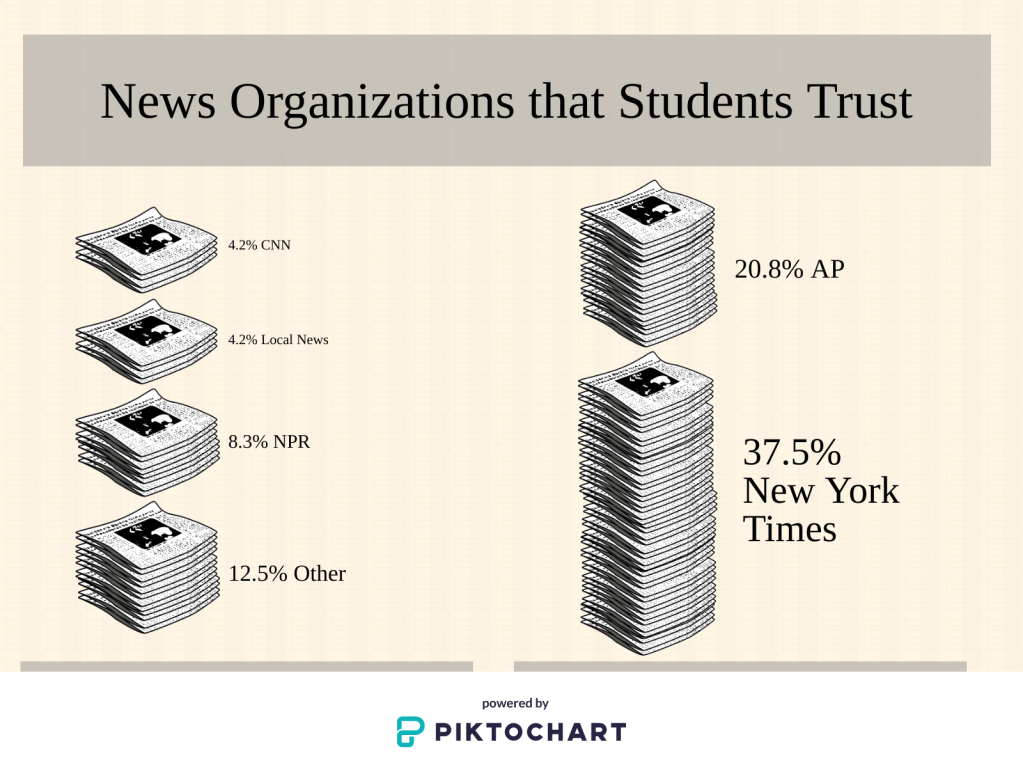
“I would say I trust The New York Times more than many other news sources, because they don’t seem nearly as bias one way or the other,” said Tracy.
To explain why students like Tracy trust The Times for their news, Clark provides some insight based on her research and experience.
“They have a long history, and an extremely strong brand,” said Clark. “It has a lot of name recognition. They have been a reputable news collector and a leader in innovation. In the 1920s The New York Times played a really pivotal role in defining what objectivity meant, and so in a lot of ways the whole history of The New York Times is tied to the idea of what we think about as quality and objective news. ”
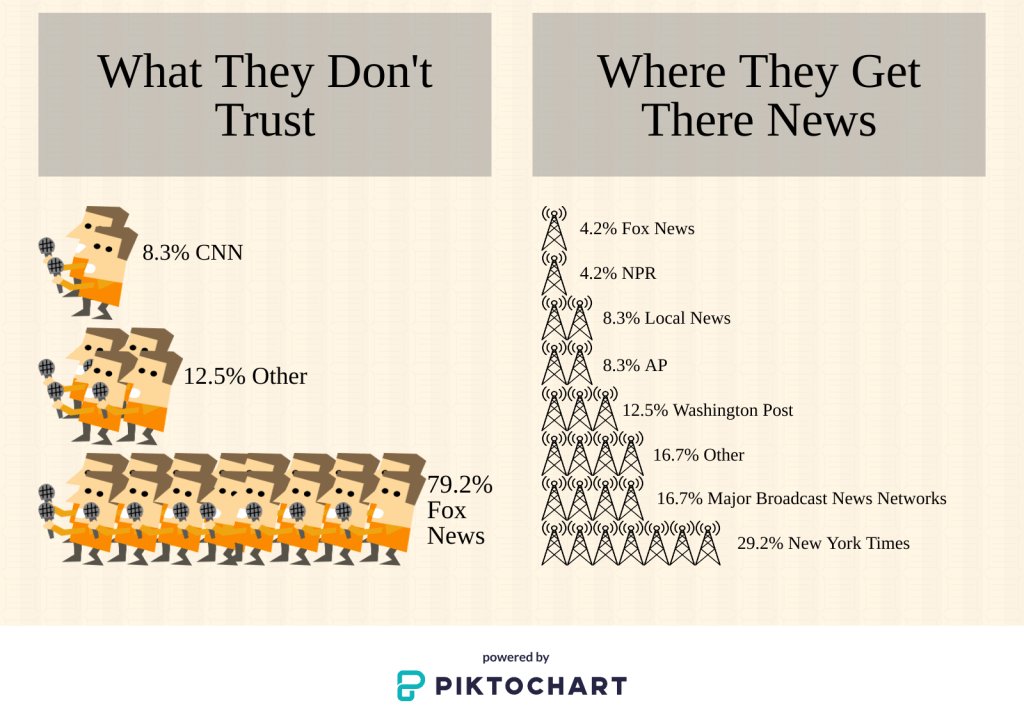
By far, students trust Fox News the least to provide objective and quality news. According to the poll, 79.2% of students trust Fox News the least to present the news fairly and accurately.
“Fox News pretends not to have a bias based on their slogan “Fair and Balanced” but yet they employ people such as Sean Hannity and formerly Bill O’Reilly who are radical political ideologues,” said Tracy.
Clark explains that this distrust relates to the landscape of partisan news that has developed in the U.S.
“The college generation has always seen through the ruse of Fox News claiming to be fair and balanced,” said Clark. “They have grown up with the idea that Fox News and all news has a perspective.”
When it comes to where students get there news, the results are surprisingly different from the results of the poll on which news organizations they trust. 29.2% of students get their news from The New York Times and 16.7% get their news from major broadcast news networks (CBS, ABC, NBC). Surprisingly, the popularity of major broadcast news does not translate to trust, 0 percent of students said they trusted them the most.
“Most people don’t spend that much time with news today when compared to 10 years ago. They [students] are spending more time on social media, so the news comes to them rather than them going to the news,” said Clark when explaining why students don’t go to the sources they say they trust for news.
A curious piece of the data is that only 8.3% of students get their news from local news organizations. Clark interprets this as a shift from the older generation, “College students are less tied to a local community. Even though adults tend to trust their local news, its the reverse for college students who tend to look for national news more. This has become even more the case as the news landscape has become fragmented.”
In this time of fragmented trust, students seem to be drifting toward syndicated news sites like Google News and Apple News. DU journalism professor Dr. Racheal Liberman claims this is due to convenience.
“As a digital native, you are very used to websites and gathering information in ways that it’s curated for you with a variety of sources in one space or application. And this is very different from older generations who are used to going to the website or getting the newspaper,” said Liberman. “Many people may not trust this curation, because then tech companies and algorithms are influencing what you see. So there are issues with it, but these curated platforms are a nice way to get a snapshot of whats going on.”
It may be a newspaper, but it isn’t black and white. With all these different platforms (Google News, The New York Times, Fox News), students are overwhelmed and conflicted. Where you get your news has become just as important as the news itself, and it is hard for students to discern truth from lies.
 The MFJS Reporter -- Winter 2020 T-R