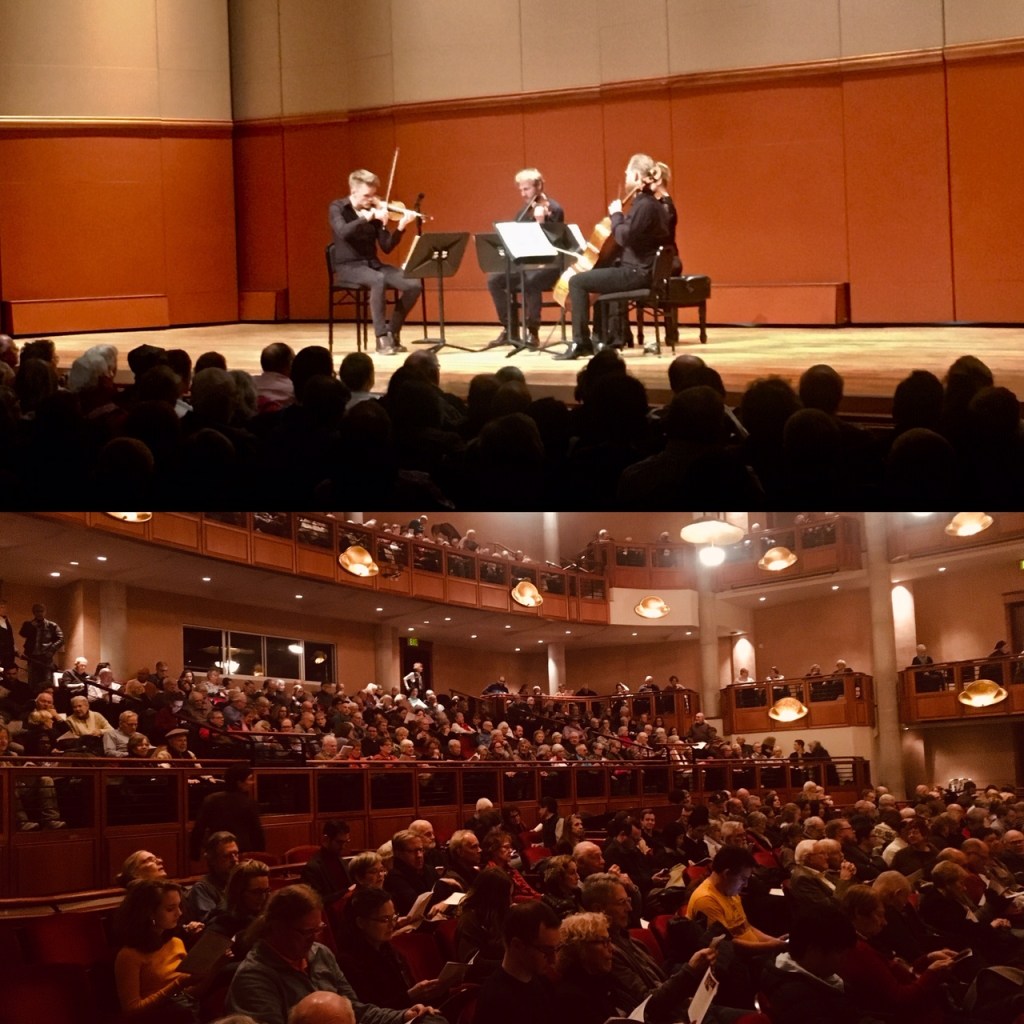
No seats were left empty inside the massive auditorium at the Newman Center. Elderly and well-dressed, the crowd chatted with their neighbors, seemingly well-informed about Beethoven’s influence on classical music to this day, clearly admirers of his music.
The Danish String Quartet, which consist of four members, Rune Tonsgaard Sørensen (violinist), Frederik Øland (violinist), Asbjørn Nørgaard (violist) and Fredrik Sjölin (cellist), pride themselves in mastering the work of esteemed classical composers like Mozart and Beethoven.
Øland, Sørensen and Nørgaard have been playing together for 22 years. Ever since they met at a summer camp for amateur musicians when they were 15 years old, they quickly became best friends.
Sørensen describes the group as a “Friendship that developed into a quartet.”
This bond clearly translates into the way they play on stage as well. Kim Meyer, a Denver resident and classical music enthusiast, explains she has seen many similar groups before, but the Danish String Quartet is by far the best because they are the most comfortable with each other.
“The musicians can even anticipate each other’s movements while playing,” Meyer explains.
Once Øland, the first violinist, began playing the group’s opening piece, No. 3 in D Major, the whole auditorium changed attitude. A concert hall which once held pretentious adults competing to demonstrate their knowledge of Beethoven, sat enthralled, even childlike, as heavenly music slowly flowed like ocean waves around them.
For someone who does not listen to classical music, I was surprised to be feeling its hypnotic powers. This music is unlike what most millennials listen to today because it is slower and lacks a techno beat. The unconventional nature is what makes this music special.
Even Øland describes the first piece as “weird and brave” because of the sharp change from light to powerful in the middle. The musicians moved their bodies in unison like magnets, as the music got louder after each repetition, creating a hybrid sonata-rondo structure. When the group hit the final note, leaving their 16th century instruments screaming, I felt my own heart pounding, as if I were on stage ending with a showstopper.
Jadon Cochran, a DU student and musician at the Lamont Symphony Orchestra, says, “I love watching talented professionals like them because I really want to be in their shoes someday.”
The quartet explains the pieces they play express two very different parts of Beethoven’s life. In the first piece No.3 in D major, Op. 18, No. 3 Beethoven moved to Vienna to study with Austrian composer, Joseph Haydn. During the second piece, No. 9 in C major Op. 59, No. 3, “Razumovsky” Beethoven was deaf, so the music is structurally complex.
Sørensen explains, “Beethoven wanted this piece to be more complicated than the rest. He wants to turn everything upside down which is frustrating for musicians because it goes against everything you are taught to do.”
Though it may have been frustrating for the musicians, it certainly did not disappoint the audience. The dark notes dragged out by the violinists created a romantic effect as they got deeper, telling a different story for each individual.
The auditorium that had been respectfully silent for two hours, suddenly erupted in applause and cheers for the quartet, now taking a bow. The patrons were finally able to release their long overdue praise.
As I put on my jacket and headed for the door, I remembered what Sørensen had said at the beginning of the show, “we have a responsibility to keep playing music and spreading his words.”
This driven attitude is what keeps Beethoven’s legacy alive– it inspires musicians in the audiences to practice harder and gives fans a few hours of joy.
 The MFJS Reporter -- Winter 2020 T-R