Statistics for recent elections show that there has been an increase in voter participation in the 18-to 2- year old demographic. However, these numbers are low compared to older generations. Young voter participation is on the rise, but there may still be more we can do to amend this imbalance.
“Young people are still getting used to their roles in society,” said Kelsey Way, a second-year student at the University of Denver. Way noted that a possible cause for the lack of younger generations voting may be a lack of understanding of the political process and its importance to our society.
The Harvard Kennedy School notes a strong relationship between the educational environment and political participation among young voters. A possible reason for a lack of young voters is apathy towards politics which is further intensified by the lack of an environment to express political thoughts and questions.
“No one has taught us how to vote,” said Sophia Bricker, a first-year student at the University of Denver.
Education of our political system is an overarching theme when considering the issue of low rates among young voters.
Both Bricker and Way noted that they had almost no education in high school about the voting process and political involvement. This is especially interesting because Way attended a private catholic high school in California while Bricker attended a public Colorado high school. This shows a lack of political education across the country.
It is clear that education about our government could be a possible area of growth, but what specific changes need to be made? Will changes in our education system actually make a significant change?
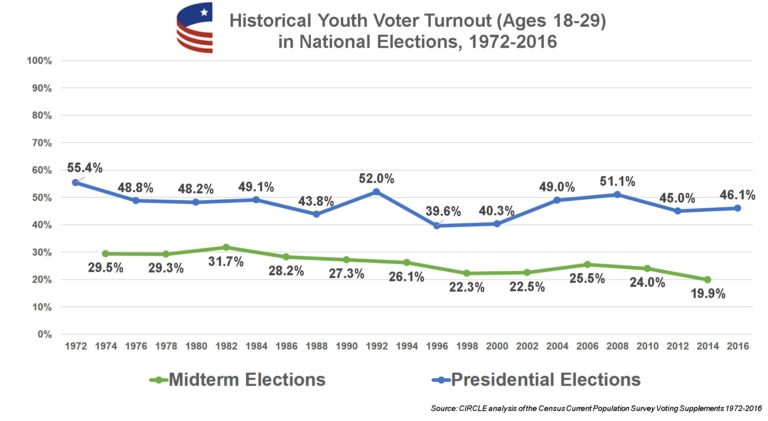
The 2018 midterm election saw an increase in 18-to 29-year-old voter participation in comparison to the previous midterm election. However, the 36% of young people that voted is very low when compared to 49% of the 30-44 age group and 60% of the 45-64 age group. It is important to note that in general, overall voter participation is lower during midterm elections when compared to presidential elections.
So is the younger generation participating more in politics and what can we expect in the political future from this age group?
A possible explanation for the most recent rise in young voter participation is the increasingly heated political climate that has been brewing since the 2016 presidential race. “People got fired up in 2016, it became personal to people,” said Lizzie Fanslow, a second-year business student at the University of Denver.
This shift in youth activism could mean political changes in the future. Events like the Parkland shooting may be one cause of this shift in attitude toward our political process. It is still in question though whether this activism will actually result in increased young voter participation.
“You can register, but voting is actually where it matters,” noted Bricker.
 The MFJS Reporter -- Winter 2020 T-R